
Modern organizations operate in an environment defined by uncertainty. Digital transformation, distributed workforces, third-party dependencies, and increasing cyber and climate risks have fundamentally altered how disruptions impact operations. A single incident - whether a ransomware attack, power outage, supply chain failure, or severe weather event - can halt operations, erode customer trust, and create long-term financial and reputational damage.
Business continuity planning (BCP) exists to reduce that risk.
According to the U.S. Federal Emergency Management Agency (FEMA), more than 95% of emergencies are predictable, meaning organizations can anticipate and prepare for the majority of disruptive events they will face. Yet despite this predictability, many organizations still rely on ad hoc documentation, outdated spreadsheets, or informal institutional knowledge to guide response and recovery. Gartner and Deloitte research consistently show that operational resilience and continuity capabilities lag behind the pace of digital and organizational change. This guide provides a comprehensive, step-by-step framework for building a modern business continuity program - one that is scalable, measurable, and adaptable across industries and organization types.
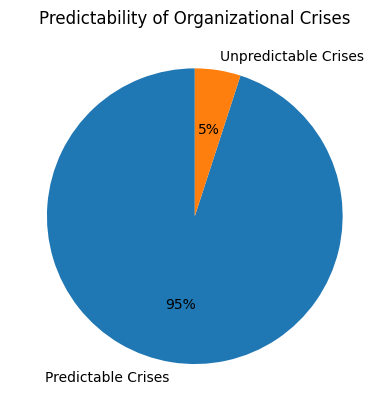
This chart reflects FEMA guidance that most emergencies are foreseeable and can be planned for. The 95% / 5% split represents FEMA’s position that the majority of disruptions fall into predictable categories.
Source: https://www.fema.gov/emergency-managers/national-preparedness/plan
Business continuity planning is the discipline of ensuring that critical business functions continue at acceptable levels during and after a disruption. It focuses on sustaining operations - not just responding to emergencies or restoring IT systems.
This distinction is critical. Many organizations mistakenly treat business continuity, emergency response, and disaster recovery as interchangeable concepts. In reality, each serves a distinct purpose:
FEMA’s Four Phases of Emergency Management - mitigation, preparedness, response, and recovery - provide a widely accepted framework for understanding how these disciplines work together without overlapping responsibilities. Without a shared definition, organizations experience misaligned expectations, unclear ownership, and gaps between planning and execution.
Key Deliverables
Quick Start Action
Document and validate a shared continuity definition with leadership before launching detailed planning.
Business continuity planning must be grounded in reality. This begins with two foundational activities:
Federal guidance emphasizes an all-hazards approach, which ensures organizations prepare for both high-likelihood events and low-frequency, high-impact scenarios.
The BIA introduces measurable recovery targets such as:
Research from Deloitte indicates that fewer than 40% of organizations maintain an enterprise-wide, fully documented business continuity framework, leaving many unable to prioritize recovery effectively during a crisis.
Key Deliverables
Quick Start Action
Conduct a pilot BIA for one department to identify dependencies and acceptable downtime.
Business continuity is not a solo effort. Effective programs rely on clear governance structures that define accountability across the organization.
Governance answers essential questions:
The Business Continuity Institute (BCI) reports that organizations with formal governance models recover faster and experience fewer decision bottlenecks during incidents. Without governance, continuity efforts become fragmented and difficult to sustain.
Key Deliverables
Quick Start Action
Appoint an executive sponsor and form a cross-functional continuity committee.
Once priorities and ownership are established, organizations must document how work will continue during disruptions.
Continuity strategies typically address:
McKinsey research shows that organizations with predefined response playbooks reduce downtime by 30-40% during major disruptions compared to those relying on improvisation.
Key Deliverables
Quick Start Action
Create a continuity playbook for one mission-critical system or process.
Business continuity defines what must continue; disaster recovery defines how technology supports that outcome. Alignment between the two is essential.
Many organizations discover a significant gap between business expectations and IT recovery capability. Gartner estimates the average cost of IT downtime at $5,600 per minute, making unrealistic recovery assumptions financially dangerous. This misalignment often results in false confidence; plans appear complete but fail under real-world conditions.
Key Deliverables
Quick Start Action
Review recovery targets for your top three business functions with IT leadership.\
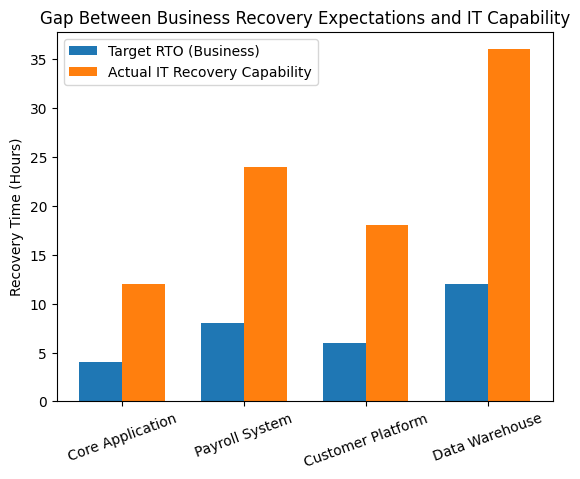
This chart reflects patterns commonly identified in Business Impact Analyses (BIAs) and disaster recovery assessments, supported by industry research on downtime costs and recovery performance. Industry research consistently shows a gap between business continuity expectations and technical recovery capacity, along with the significant financial impact of downtime.
Source: https://www.ibm.com/reports/data-breach
A continuity plan that hasn’t been tested is a hypothesis.
Testing validates assumptions, reveals gaps, and builds confidence. FEMA and Ready.gov recommend testing continuity plans multiple times per year, using a mix of tabletop exercises, functional tests, and simulations. Organizations that conduct regular testing identify weaknesses earlier and recover more quickly during real incidents.
Key Deliverables
Quick Start Action
Run a tabletop exercise simulating a critical system outage and evaluate decision-making and communication.
Business continuity is a living program, not a static document. Organizational change, including new systems, vendors, and leadership turnover, can quickly render plans obsolete. BCI research consistently identifies outdated plans as a leading cause of continuity failure.
Key Deliverables
Quick Start Action
Schedule annual plan reviews tied to significant organizational changes.
Continuity planning must account for individuals with disabilities and accessibility needs across all aspects of communication, facilities, and technology.
According to the U.S. Centers for Disease Control and Prevention (CDC), 26% of adults in the U.S. live with a disability, making accessibility a core resilience consideration across industries. Failing to address accessibility introduces compliance risk and disproportionately impacts vulnerable populations during crises.
Key Deliverables
Quick Start Action
Audit emergency communications and critical systems for compliance with accessibility standards.
Organizations that succeed in business continuity planning share common characteristics: transparent governance, realistic recovery targets, regular testing, and centralized documentation. These practices transform continuity from a compliance exercise into a strategic capability.
Prepared organizations don’t just survive disruption - they recover faster, protect trust, and sustain long-term performance. Disruption is inevitable. Chaos doesn’t have to be. By following these steps and making continuity planning a living practice, your institution can protect its mission, its people, and its future.
Kuali Ready was built to help organizations move beyond static spreadsheets and outdated binders - enabling scalable, collaborative, and always-current business continuity planning.
👉 Learn more about how Kuali Ready supports organizational resilience

Discover how Kuali connects the work behind administration, research, compliance, IT, and more.
Explore Kuali solutions ->.jpeg)
Explore business continuity plan examples and learn how universities ensure operational resilience with proactive strategies for crisis management and recovery.

Discover a streamlined, four-phase continuity planning approach for higher education—covering BIA, risk analysis, plan development, exercises, and maturity benchmarking—to embed resilience and streamline recovery efforts.

When colleges close, the economic, social, and educational impacts ripple through communities. Learn how business continuity planning protects campuses, students, and local economies.


